
Administration of an estate in South Australia can be a slow, costly process. Executors and Administrators have a duty to get it right by complying with laws and preserving the deceased's wishes or laws of intestacy. Competing interests, however, can compound the process.
At Memento Mori Legal, we understand the diverse sensitivities involved in administering an estate. With our knowledge and commitment to efficiency, we strive to provide comprehensive legal services tailored to meet the unique needs of each estate. Contact us at 0466 980 108 to schedule a consultation today or commence our Online Process, by emailing [email protected] at any time and from any place.
Overview of Estate Administration in Australia
Estate administration in Australia is governed by various laws, most of which are on a state or territory level, like the Succession Act 2023 (South Australia). Succession laws outline how an estate administrator distributes a deceased person's assets and settles their debts.
The estate administrator, also known as the Executor or Administrator, is usually appointed by the deceased in their Will (Executor) or, if no will exists, an eligible person needs to apply to the court to be appointed as Administrator. The individuals chosen to be Executors should possess qualities such as integrity, diligence, and a good understanding of financial matters. These qualities matter as they will impact upon how smoothly the administration of the estate goes which depends on their abilities.
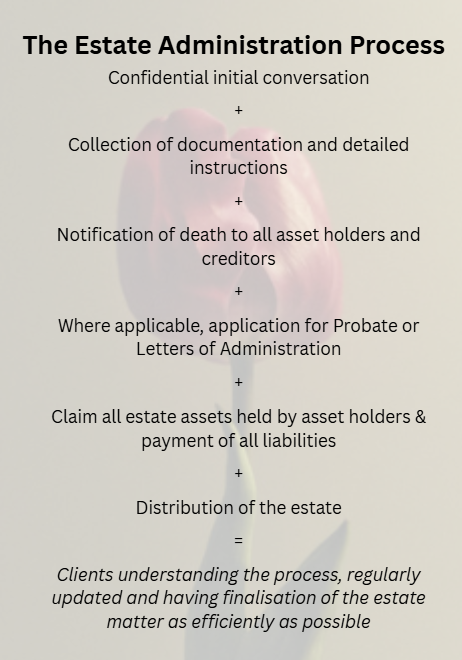
Basic Estate Administration Process in South Australia
In Australia, the estate administration process may vary somewhat among states and territories, but the process overall is the same. Those key elements are summarised below.
Identification of Assets and Liabilities
The first step in estate administration is to identify and locate all assets and liabilities of the deceased.
Examples of Assets
- Bank accounts
- Real estate
- Investments
- Shares and bonds
- Vehicles
- Insurance policies
- Retirement accounts
- Personal belongings (like jewellery, art, or heirlooms)
Examples of Debt
- Personal loans
- Home loans
- Credit card debt
- Tax obligations
- Legal obligations
Obtaining a Grant of Probate or Letters of Administration
If the deceased left a valid Will, the Executor named in the Will, usually would need to apply for a grant of Probate from the Supreme Court – all Probate & Letters of Administration applications go through a rigorous 'checks and balances' process by the Probate Registry, to safeguard your estate assets against potential fraud and mishandling. Probate is a legal document that confirms the executor's authority to administer the estate according to the terms of the Will.
If there is no valid Will or if the appointed Executor is unable or unwilling to act without any Substitute Executor, an eligible person can apply for Letters of Administration, which grants them the authority to administer the estate in accordance with intestacy laws where there is no Will or Letters of Administration with the Will annexed, where the executor of the Will is unable or unwilling without any Substitute Executor.
In order to apply for Probate or Letters of Administration the original Death certificate, original Will (if applicable), original Oath of Administrator (if applicable) and all date of death balances for estate assets and estate liabilities are to be submitted via the CourtSA online portal. If there is an original Will that will need to be personally submitted by our firm to the Probate Registry.
Notification of Beneficiaries and Creditors
Once Probate or Letters of Administration are obtained, the Executor or Administrator must notify Beneficiaries named in the Will, Asset Holders and Creditors of the grant. Creditors typically have a specified period to lodge claims against the estate.
Paying Debts and Taxes
The Executor or Administrator is responsible for settling any outstanding debts and taxes owed by the Deceased/the Estate. This may involve selling assets, using funds from the estate, or obtaining loans if necessary.
Distribution of Assets
After debts, taxes, and administrative expenses are paid, the remaining assets can be distributed to Beneficiaries according to the terms of the will or intestacy laws. This process should be carried out diligently and in accordance with legal requirements. There may be occasion where certain assets are delayed for various reasons, for example the sale of real estate; and an interim distribution can be provided to Beneficiaries.
Finalising the Estate
Once all assets have been distributed, the estate accounts are finalised, a statement of distribution is prepared. For an intestate estate the statement of distribution and other required documents which outline how the estate assets were distributed are submitted to the Public Trustee for approval. Some estates may also require the deceased's final tax return and an estate tax return; which would need to be completed prior to finalisation of the Estate.
Closing the Estate
The Executor or Administrator also finalise the estate administration process by requesting closure of bank accounts when funds are released to the Estate, transferring property titles from the Deceased to the Executor or Administrator; then, where applicable, to the Beneficiaries, and completing any other necessary administrative tasks.
Common Estate Disputes in South Australia
Despite careful planning, estate administration can sometimes be met with challenges and disputes.
- Contesting the Will: Disputes may arise when beneficiaries or potential beneficiaries feel they have been inadequately provided for in the Will. This can lead to legal challenges seeking to contest the validity of the Will or claim greater provision from the estate.
- Executor Disputes: Conflict may arise among Executors or between Executors and Beneficiaries regarding the management and distribution of the estate. This can include disputes over the interpretation of the Will, the handling of Estate assets, or allegations of Executor misconduct.
- Family Provision Claims: In some cases, family members or dependents who believe they have not been adequately provided for in the Will or by intestacy may make a family provision claim seeking greater provision from the estate. These claims can lead to disputes over the deceased's testamentary intentions and the appropriate distribution of assets.
- Property Disputes: Disputes may arise over specific assets or properties within the estate, particularly if there are disagreements about ownership, valuation, or distribution. This can include disputes over real estate, personal property, investments, or business interests.
- Tax and Financial Issues: Estate administration often involves complex tax and financial considerations, including capital gains tax, stamp duty, and estate administration tax (if applicable). Disputes may arise over the valuation of assets, tax liabilities, or the distribution of funds among beneficiaries.
- Creditor Claims: Creditors of the deceased may make claims against the estate for outstanding debts or liabilities. Disputes can arise over the validity or priority of these claims, particularly if the estate's assets are insufficient to cover all debts.
- Intestacy: If the deceased did not leave a valid Will, disputes may arise over the distribution of assets according to intestacy laws. This can involve determining rightful heirs and resolving conflicts between family members or other potential beneficiaries.
These challenges are just some of what can occur in South Australia. Resolving them often requires careful legal guidance and may involve negotiation, mediation, or litigation.
Estate Administration Legal Services in South Australia
At Memento Mori Legal, we facilitate a smooth and efficient estate administration process. We advise Executors and Administrators on their duties and responsibilities providing assistance in compliance of their role.
We assist clients with the preparation and submission of:
- Probate
- Letters of Administration applications
- Letters of Administration with Will annexed
- Estate Administration
Getting Estate Administration right depends on the kind of legal guidance you obtain – be sure to consult with us first so that we can provide the insight you need and support to move forward timely and properly.

Why Choose Memento Mori Legal for Estate Administration Guidance
Clients want estate administration to be as seamless and hassle-free a process, as possible. Here are just a few reasons why you should retain our estate administration services at Memento Mori Legal.
- Our experience and knowledge of estate planning.
- We take a personalised approach to your specific needs and circumstances.
- We have created systems of efficiency to seek to reduce the usual causes for delays in Estate Administration.
- We are compassionate and provided dedicated support throughout every stage of the process.
The combination of these qualities and qualifications enables Memento Mori Legal to look after each individual client with care and commitment to seeing you through this difficult time.
Contact Memento Mori Legal Estate Administration Today
It can be difficult to navigate the complexities of estate administration alone. Contact Memento Mori Legal today on 0466 980 108 to schedule a consultation or commence our Online Process, by emailing [email protected] at any time and from any place. Let us guide you through the process and provide the peace of mind you deserve during this challenging time. Your loved one's legacy deserves to be handled with care and expertise.